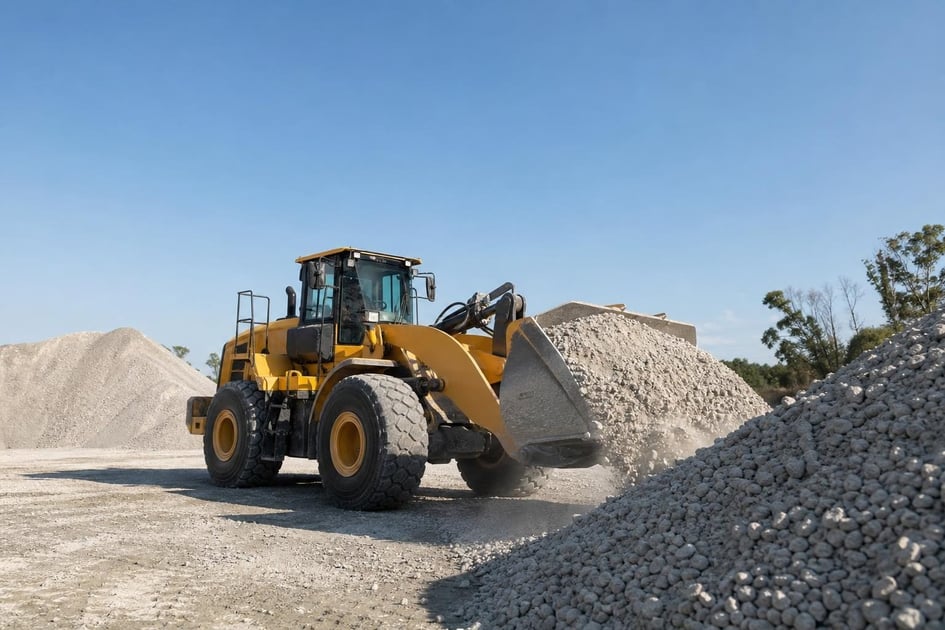
If you need a wheel loader in Florida, equipment financing lets you acquire the machine without draining operating cash. The loader itself serves as collateral, which keeps rates competitive and allows same-day approvals for qualified buyers. Provide Capital finances wheel loaders from $5,000 to $5 million for Florida contractors, farmers, landscapers and waste operators statewide.
By the Numbers: Florida is home to more than 85,000 construction firms, one of the largest state-level concentrations in the country, according to U.S. Census Bureau business data. That density of contractors keeps demand for wheel loaders consistently high through the dry season and into hurricane-recovery cycles.
Why Wheel Loaders Are Essential in Florida
Florida’s geography and climate create year-round demand for wheel loaders. During the October-to-May dry season, commercial and residential construction accelerates across the state. Contractors use wheel loaders for site prep, material handling and backfilling. When hurricane season arrives, the same machines pivot to debris removal, levee maintenance and emergency road clearing. A single wheel loader can replace multiple pieces of smaller equipment if it is specced correctly.
The state’s limestone base and sandy soils are abrasive on undercarriages and bucket edges. Florida operators typically see higher wear-part costs than contractors in the Midwest, so buying a machine with adequate lift capacity and the right bucket package matters more than shaving a few dollars off the sticker price. Agricultural buyers in the sugarcane and citrus belts use wheel loaders for loading field bins and stacking pallets, while Central Florida mining and phosphate operations run them in quarries where dust control and cooling-system capacity are critical.
Transportation logistics also differ in Florida. Because the peninsula is narrow and railroad freight options are limited compared to the Midwest, many dealers deliver by lowboy truck. Delivery costs can run higher, especially into the Keys or the Panhandle, so it is worth confirming whether freight is wrapped into the financed amount or paid separately. Sustained federal infrastructure spending continues to support heavy construction activity across the Southeast, according to AP News infrastructure reporting, which keeps demand for loaders elevated on public works sites.
Get a fast decision on your equipment
Applying takes just a few minutes, and decisions can come as soon as the same day.
Start Your ApplicationWhat Wheel Loader Financing Covers
Equipment financing through Provide Capital covers the machine, attachments, freight, installation and applicable sales tax. You can finance a compact loader for a landscaping crew or a 400-horsepower production loader for a quarry. The collateral is the equipment itself, which means you do not need to pledge real estate or inventory to secure the loan.
Financing amounts range from $5,000 to $5 million. Terms generally run from 24 to 84 months, depending on the equipment age, your credit profile and the intended use. Rates vary by credit profile, equipment age and term. Because the machine secures the financing, lenders can offer more flexible structures than unsecured working-capital products. The U.S. Small Business Administration loan programs also finance machinery and equipment, though direct equipment lenders often move faster for collateral-backed purchases.
New vs. Used Wheel Loaders
New wheel loaders offer full manufacturer warranties, lower maintenance costs in the first three years and the latest emissions controls. For Florida buyers, new machines also come with factory air-conditioning systems designed for the state’s heat and humidity. The downside is depreciation: a new loader can lose 20 to 30 percent of its value in the first year.
Used wheel loaders are attractive when the budget is tight or when the machine will see intermittent use. A three- to five-year-old loader with 2,000 to 4,000 hours can cost 40 to 60 percent less than new. In Florida, however, check the hour meter against the service records carefully. Salt-air exposure near coastal job sites accelerates corrosion, and machines that worked phosphate or mining applications may have hidden frame stress.
Financing terms differ between new and used. Lenders typically offer longer terms on new equipment because the residual value is predictable. On used machines, expect slightly shorter terms or a larger down payment if the unit is more than seven years old or has over 8,000 hours. Provide Capital finances both new and used loaders, including private-party sales and auction purchases, provided the machine can be inspected and titled.
See what you qualify for on a new or used wheel loader today.
Key Insight: Florida’s dry season runs roughly October through May, which means contractors who order wheel loaders in the fourth quarter often take delivery just as job-site activity peaks. Financing the purchase in Q1 aligns your first payments with the revenue surge that follows, improving cash-flow timing.
Lease vs. Loan: Choosing the Right Structure
The decision between leasing and taking an equipment loan depends on how long you plan to keep the loader, how many hours it will run annually and what you want to do at the end of the term.
| Factor | Equipment Loan | Operating Lease |
|---|---|---|
| Ownership | You own the loader after the final payment | Lessor owns the asset; you return or buy it |
| Down payment | Often $0 to 10% | Usually one or two advance payments |
| Term | 24–84 months | 24–60 months |
| End-of-term | $1 buyout or automatic title transfer | Return, renew or purchase at FMV |
| Best for | High-hour, long-term use | Short projects or technology turnover |
| Tax treatment | Section 179 and depreciation | Payments may be deductible as operating expense |
If you plan to run the loader for 1,500 hours per year and keep it for eight years, a loan is usually the better fit. If you need a high-horsepower machine for a specific two-year infrastructure job and want to avoid resale risk, a lease preserves capital. Provide Capital offers both structures and will walk through the trade-offs with your accountant.
Tax Treatment for the 2026 Tax Year
Wheel loaders qualify as tangible personal property under IRS rules, which means they are generally eligible for Section 179 expensing and bonus depreciation. For the 2026 tax year, the exact deduction limits and phase-out thresholds are set by IRS guidance. Speak with a CPA to confirm the current-year limits and how they apply to your specific tax situation.
If you finance a loader in 2026, you can usually take the deduction in 2026 even though you are making payments over several years. This front-loaded tax benefit is one of the main reasons contractors choose to finance equipment purchases in the fourth quarter. However, if you lease the machine, the tax treatment changes: lease payments are typically deductible as operating expenses, but you do not depreciate the asset. Your CPA can model which approach produces the better outcome based on your taxable income and other capital expenditures.
The equipment must be placed in service during the 2026 tax year to qualify for 2026 deductions. Delivery delays at the manufacturer or shipping bottlenecks can push placement into the next year, so confirm lead times before you commit to a December closing.
Qualification Criteria
Provide Capital evaluates four main factors when reviewing a wheel-loader application: time in business, credit history, annual revenue and the equipment itself.
Time in business matters because equipment lenders want evidence that you have managed cash flow through seasonal cycles. Two years is a common benchmark, though newer businesses with strong credit and a large down payment may still qualify. Credit scores are reviewed, but there is no universal cutoff; a 640 score with strong bank deposits and a clean equipment history is often viewed more favorably than a 720 score with recent overdrafts and tax liens.
Revenue is measured against the proposed payment. Lenders typically want to see that the new equipment payment does not exceed a reasonable percentage of monthly gross revenue. The exact ratio varies by industry. Collateral value is the final piece. Because the wheel loader secures the financing, its age, brand, hour count and condition all influence approval amount and term. A late-model Caterpillar, Deere or Komatsu loader with under 3,000 hours will command better terms than a 12-year-old off-brand unit with incomplete maintenance records.
Worked Cost Examples
Below are illustrative scenarios for Florida buyers. Rates vary by credit profile, equipment age and term, so treat these as directional only.
Example 1: Compact loader for a landscaping contractor
- Equipment: Used compact wheel loader, three years old, 1,800 hours
- Financed amount: $65,000
- Term: 60 months
- Estimated monthly payment: $1,250–$1,450
Example 2: Production loader for a Central Florida quarry
- Equipment: New 200-horsepower wheel loader with bucket and forks
- Financed amount: $285,000
- Term: 72 months
- Estimated monthly payment: $4,400–$4,900
Example 3: Mid-size loader for a sugarcane haul operation
- Equipment: Four-year-old loader with 3,200 hours, recently rebuilt transmission
- Financed amount: $110,000
- Term: 48 months
- Estimated monthly payment: $2,500–$2,850
Payments can be structured monthly, quarterly or seasonally. A sugarcane or citrus grower who earns most of their revenue during harvest may prefer a skip-payment structure that concentrates larger payments into the revenue months.
Pro Tip: Always budget for attachments separately in your financing request. A wheel loader without forks, a grapple or a specialized bucket is only half useful. Adding $8,000 to $15,000 in attachment costs into the loan upfront prevents a second financing event six months later and keeps your blended rate consistent.
Find the right financing structure
Tell us about the equipment you need and we will show you the options that fit your business.
See Your OptionsIndustry-Specific Use Cases in Florida
Construction and Site Development
General contractors in Orlando, Tampa and Jacksonville use wheel loaders for backfilling foundations, loading trucks and moving aggregate. In South Florida, where space is tight, compact articulating loaders are preferred for residential infill. Construction equipment financing is structured around job timelines, so contractors often match the loan term to the average duration of their contracts.
Agriculture and Farming
Florida’s agricultural belt runs from the Everglades through the central ridge. Sugarcane growers use loaders to stack harvested cane onto trailers. Citrus operators use them in packing houses to move bins. Dairy farmers in the Panhandle use loaders for feed and manure handling. The machines run long hours in dusty conditions, so agricultural buyers should prioritize enclosed cabs with filtration and air conditioning.
Forestry and Land Clearing
North Florida and the Panhandle have active timber and land-clearing markets. Wheel loaders fitted with grapple buckets handle slash piles and load logging trucks. These applications demand high-lift configurations and reinforced frames. Because forestry work is cyclical, many operators prefer seasonal payment structures that match the timber-harvest calendar.
Waste and Recycling
Florida’s population growth produces steady waste volumes. Transfer stations and recycling yards use wheel loaders to push material, load haul trucks and stockpile sorted commodities. Waste applications are high-cycle and abusive, so buyers in this sector often finance new or recent-model machines to minimize downtime.
Common Mistakes to Avoid
Underbuying lift capacity. A loader that is too small for your material density forces longer cycle times and premature drivetrain wear. Calculate the weight of a heaped bucket of your typical material, not just the rated payload.
Ignoring total cost of ownership. Fuel consumption, tire replacement and scheduled maintenance often exceed the monthly finance payment. A fuel-efficient loader with a strong dealer network in Florida can save more than the purchase-price difference over five years.
Buying without an inspection. For used machines, hire a qualified technician to check the frame, transmission, differential and hydraulics. In Florida, pay special attention to corrosion from coastal air and evidence of phosphate-dust infiltration in the radiator and air cleaner.
Neglecting insurance requirements. The lender will require physical-damage insurance on the collateral. Confirm with your agent that the premium fits your budget before you sign. Some Florida insurers charge higher rates for equipment stored in hurricane-prone zones.
Forgetting about UCC filings. The lender will file a UCC-1 lien on the equipment. If you later try to use the loader as collateral for another loan, the new lender will see the existing lien. Plan your capital stack accordingly.
Documentation You Will Need
Gathering paperwork before you apply speeds approval. Most Florida borrowers submit:
- Three to six months of business bank statements
- A quote or purchase agreement for the specific wheel loader
- Current business license or registration
- Proof of insurance or a binder letter
- Two years of business tax returns (for larger requests)
- Driver’s license and Social Security number for each guarantor
If you are buying from a private seller, the lender will also need the seller’s title or lien-release letter. Auction purchases require an invoice and proof of payment to the auction house. Provide Capital can close directly with the dealer or seller, so you do not need to pay out of pocket and wait for reimbursement.
Get a same-day decision on your equipment by submitting an application with your quote attached.
What Happens After Approval
Once approved, you will receive a term sheet outlining the payment, term, collateral description and any conditions. Review it with your accountant or attorney. After you accept, the lender sends funds directly to the dealer or seller, or issues a check payable to both you and the seller.
The UCC filing is recorded with the Florida Secretary of State or the appropriate county, depending on the transaction structure. You take delivery, put the machine to work and begin making payments on the schedule you selected. Most lenders report to business credit bureaus, so on-time payments can strengthen your business credit profile for the next purchase.
At the end of the term, the lender releases the lien and you hold clear title. If you financed through a lease, you either return the machine, negotiate a purchase at fair market value or roll into a new lease.
Complementary Equipment to Consider
Many Florida contractors who finance a wheel loader also need complementary machines. A Skid Steer Loader financing package can cover a compact track loader for tight-access work. If you are moving material off-site, Dump Trucks financing lets you haul without subcontracting. For utility or tree-care contractors, Bucket Trucks financing extends your fleet vertically. Bundling multiple units into one financing application can simplify paperwork and improve overall terms.
Key Insight: Hurricane-recovery demand in Florida can spike used-loader prices by 15 to 25 percent in the months following a major storm. Contractors who pre-approved financing before the season starts can lock in machine prices before the surge and deploy immediately when emergency contracts are released.
Ready to move forward?
More than 10,000 businesses have financed equipment with Provide Capital. See what you qualify for today.
Get StartedFrequently Asked Questions
Can I finance a wheel loader with no money down?
Yes, qualified borrowers can often finance 100 percent of the purchase price, including freight and attachments. The equipment itself serves as collateral, which reduces the lender’s reliance on a cash down payment. Strong credit and documented revenue improve your chances of a zero-down approval.
How long does approval take?
Many applications receive a decision the same day if the documentation is complete. Larger requests or transactions involving private-party sellers may take 24 to 48 hours while the collateral is verified. Submitting a clean equipment quote and recent bank statements is the fastest way to move.
Does my credit score have to be perfect?
No. Equipment financing is collateral-backed, so lenders can approve a wider range of credit profiles than unsecured lenders. Recent bankruptcies, tax liens or judgments can complicate approval, but they do not automatically disqualify you. Be prepared to explain any negative marks and show recent positive cash flow.
Can I finance a wheel loader from a private seller or auction?
Yes. Provide Capital finances dealer purchases, private-party sales and auction acquisitions. The key requirements are a clear title, an acceptable inspection and a purchase agreement or invoice. The lender will verify the seller’s ownership and any existing liens before releasing funds.
What happens if I want to pay off the loan early?
Most equipment loans allow early payoff. Some structures include a prepayment penalty in the first 12 to 24 months; others have no penalty at all. Review the term sheet carefully before you accept. If early payoff is important to you, ask your financing specialist to structure the loan accordingly.
Do I need to carry special insurance?
The lender will require physical-damage insurance naming them as loss payee. General liability is also strongly recommended, especially on commercial job sites. If you store the loader in a flood zone or coastal area, consider inland marine or flood coverage. Your agent can bundle the required coverage into an existing policy.
Can I finance attachments with the loader?
Yes. Buckets, forks, grapples, snow pushers and other attachments can be rolled into the same financing package. It is usually more efficient to finance them together than to arrange separate credit for accessories later.
Is a wheel loader the right machine for my job?
If you move loose material—dirt, gravel, sand, mulch, scrap or palletized goods—on relatively firm ground, a wheel loader is usually the most efficient choice. For excavation or trenching, a backhoe or excavator is more appropriate. For tight spaces, a skid steer may fit better. Wheel Loaders financing is ideal when you need high volume, long reach and fast cycle times.
Next Steps
Start with a quote for the specific wheel loader you want, including attachments and freight. Then gather your last three months of bank statements and your business license. With those in hand, you can receive a financing decision quickly and close before your next job starts.
Talk to a specialist about your specific machine and see how equipment financing can keep your cash working while you put the loader to work.
Disclaimer: The information provided in this article is for general educational purposes only and is not financial, legal, or tax advice. Funding terms, qualifications, and product availability may vary and are subject to change without notice. Provide Capital does not guarantee approval, rates, or specific outcomes. For personalized information about your business funding options, contact our team directly.