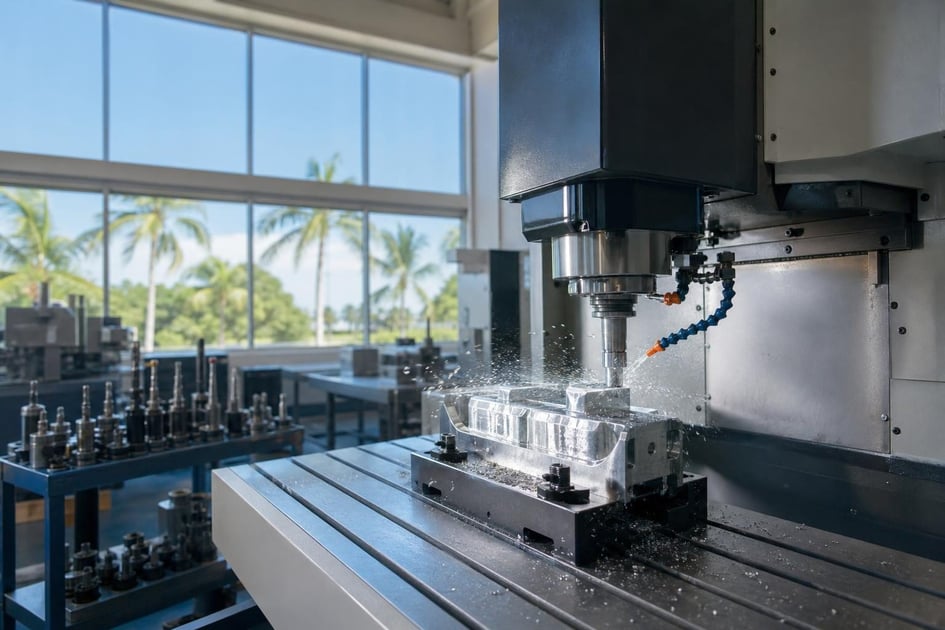
CNC machine financing in Florida works like any other equipment loan: the machine itself serves as collateral, which keeps rates competitive and lets you preserve cash for payroll, materials, and shop overhead. Provide Capital finances new and used business equipment from $5,000 to $5 million, with same-day approvals possible for complete applications. Rates vary by credit profile, equipment age and term length, so a shop with strong revenue buying a two-year-old vertical mill will see different terms than a newer business financing a twenty-year-old lathe.
Because the equipment secures the loan, lenders care as much about the machine's value and condition as they do about the borrower's financial history. That is why a buyer with a solid equipment quote from a reputable vendor can often move faster than someone seeking an unsecured line of credit. If you are looking at a specific machine, Cnc Machines financing lets you tie the loan directly to the asset you need.
By the Numbers: Equipment financing through Provide Capital starts at $5,000 and runs up to $5 million. Most CNC loans for owner-operators fall between $75,000 and $400,000, with terms typically ranging from 24 to 84 months depending on the machine's useful life and the borrower's credit profile.
Why Florida Shops Are Upgrading CNC Equipment Now
Florida ranks among the nation's most populous states, and its manufacturing base reflects that scale. According to Census Bureau manufacturing data, Florida sits in the top tier of states for total manufacturing employees even though its per-capita manufacturing output is lower than smaller industrial states. That gap is an opportunity: it means plenty of shops have room to add capacity and capture work that is currently outsourced.
The state's CNC demand is not driven by one industry. Along the Space Coast, aerospace contractors machine tight-tolerance components for satellite and defense programs. In Tampa and Fort Lauderdale, marine fabricators cut propellers, hull fittings, and custom hardware. Orlando and Jacksonville host medical device job shops that run titanium and stainless on multi-axis mills. Then there are the general fabrication shops serving construction, agriculture, and food processing across the state. Each of these segments needs reliable equipment, and many owners are choosing to upgrade now rather than risk losing contracts to better-equipped competitors.
The SBA has also signaled strong support for domestic manufacturers. The SBA Made in America loan guarantee offers a 90 percent federal guarantee on certain loans for manufacturers starting May 1, and the agency waived loan fees for small manufacturers in fiscal year 2026. The SBA MARC loan program for manufacturers adds a new revolving credit option for working capital. Combined with equipment financing from private lenders, Florida shop owners have more capital access than they did two years ago.
Key Insight: Florida's hurricane season creates a secondary demand cycle for CNC-equipped shops. When storm damage spikes construction and marine repair work, contractors with in-house machining capacity can turn around custom fittings faster than shops that outsource. Financing a CNC machine before the June through November season lets you bid on emergency repair contracts without scrambling for equipment.
Get a fast decision on your equipment
Applying takes just a few minutes, and decisions can come as soon as the same day.
Start Your ApplicationWhat You Can Finance
Eligible CNC equipment includes vertical and horizontal machining centers, CNC lathes and turning centers, routers, plasma and waterjet cutters, EDM machines, and multi-axis mills. You can finance both new and used equipment, including private-party purchases and auction wins, as long as the machine can be appraised and insured. Many lenders also allow you to bundle tooling, software, and installation costs into the same loan, which is useful when a new five-axis mill requires a post-processor and specialized fixturing.
Shops rarely buy just one asset. If you are expanding your floor, you can finance material handling equipment alongside your primary machine. Many owners add Scissor Lifts financing to move heavy stock safely, or pair a new CNC router with a forklift and compressed-air upgrades. As long as the total package is within the program limits and each item serves the business, it can be included in a single application.
New vs. Used CNC Machines: Making the Right Choice
The new versus used decision is usually about speed versus cash flow. A new machine comes with a warranty, the latest control software, and faster spindle speeds, but it also carries a higher monthly payment and steeper depreciation in the first year. A used machine costs less upfront, which keeps the loan balance smaller and the monthly payment lower, though you may inherit maintenance issues or obsolete controls.
For a Florida shop bidding on aerospace or medical work, a new machine's precision and documentation trail can be worth the premium. For a general fabrication shop cutting aluminum brackets or signage, a three- to five-year-old used mill with a proven control may deliver identical output at half the acquisition cost.
| Factor | New CNC Machine | Used CNC Machine |
|---|---|---|
| Acquisition cost | Higher ($150,000–$500,000+ for mid-size mills) | Lower ($40,000–$200,000 for comparable specs) |
| Financing term | Up to 84 months | Up to 60 months, depending on age |
| Warranty | Full manufacturer warranty | Limited or none; factor in repair reserve |
| Control/software | Latest interface, built-in simulation | May require retrofit or external post-processor |
| Best for | High-tolerance, production-volume work | Job shops, first-time buyers, backup machines |
Neither choice is automatically correct. The right machine is the one whose monthly payment leaves enough cash flow to cover labor, materials, and unexpected repairs while the machine earns its keep.
Equipment Loan vs. Lease
An equipment loan and a lease solve different problems. With a loan, you own the machine at the end of the term, and you can claim depreciation and Section 179 deductions for the 2026 tax year. With a lease, you make lower monthly payments for the right to use the machine, which preserves more cash flow in the short term, but you do not build equity unless you exercise a purchase option at the end.
Loans make sense when the machine has a long useful life and you want to own it outright. Leases work better when you need to preserve capital for a growth phase or when the technology is changing so fast that you expect to upgrade every three to five years. For most Florida job shops with steady contract flow, a loan is the more common structure because the equipment retains value and the tax benefits tilt toward ownership.
| Feature | Equipment Loan | Equipment Lease |
|---|---|---|
| Ownership | You own the machine after the final payment | Lessor owns the machine; you may have a buyout option |
| Monthly payment | Higher, but builds equity | Lower, but no equity unless you buy out |
| Tax treatment | Section 179 and depreciation for 2026 | Payments typically deductible as operating expense |
| Down payment | Often 0% to 20% | First and last payment, or minimal down |
| Best fit | Long-term assets with stable technology | Rapidly evolving tech or short-term projects |
If you are unsure which structure fits your shop, see what you qualify for and compare the payment scenarios side by side before you commit to a machine.
Pro Tip: Before you sign for a used CNC machine, verify that the control software license is transferable. Some manufacturers require a $3,000 to $10,000 software re-licensing fee when a machine changes ownership, which is not included in the purchase price. Ask the dealer for a written confirmation of license transferability and factor that cost into your total project budget.
Qualifying for CNC Machine Financing
Provide Capital does not publish hard minimum credit scores or revenue thresholds, because the equipment itself mitigates much of the lender's risk. That said, the strongest applications usually come from businesses with at least two years of operating history, consistent monthly revenue, and a credit profile that shows timely payments on existing trade lines. Startups and new businesses are outside the scope of this program.
The documentation required is straightforward. You will need the equipment quote or invoice, three to six months of business bank statements, and a one-page application. If the loan amount exceeds $250,000, expect to provide two years of tax returns and a current year-to-date profit and loss statement. The underwriter may also request a vendor inspection or appraisal for used machines priced above $100,000 to confirm condition and market value.
Time in business matters more than perfect credit. A shop that has been running for five years with stable deposits can often qualify for a larger amount than a newer business with a higher credit score but thinner financials. If your credit has blemishes, be prepared to explain them and show how the new machine will generate revenue to cover the payment.
Find the right financing structure
Tell us about the equipment you need and we will show you the options that fit your business.
See Your OptionsTax Treatment and Section 179 for 2026
For the 2026 tax year, businesses that purchase qualifying equipment may be able to deduct the full cost in the year of purchase under Section 179, subject to annual limits set by Congress. The exact dollar limit for 2026 is established by the IRS and should be confirmed with your CPA before you file. If your total equipment purchases for the year exceed the threshold, bonus depreciation may allow you to write off a percentage of the remaining cost, though the rules phase down over time. Because tax law changes frequently, any figure cited here could be revised by the IRS, so speak with a qualified accountant before making a purchase decision based on tax benefits.
The equipment must be placed in service during the 2026 tax year to qualify for that year's deductions. That means ordering a machine in December but not having it installed until January could push your deduction into 2027. If you are financing the purchase, you can still claim Section 179 on the full equipment cost even though you are making payments over time, which is one of the reasons equipment loans are popular among owner-operators.
Florida Industries That Rely on CNC Financing
Florida's manufacturing economy is diverse, which means CNC financing is not limited to one niche. Aerospace suppliers on the Space Coast machine Inconel and aluminum for satellite components. Marine fabricators in the Gulf Coast machine bronze and stainless for propulsion systems. Medical device shops in Orlando and Tampa run tight-tolerance plastics and titanium. Then there are the general job shops that serve construction, agriculture, and food processing equipment needs statewide.
Each segment has different equipment requirements. Aerospace tends toward four- and five-axis mills with high-speed spindles. Marine shops often need large-bed routers and lathes that can handle shaft work. Medical device manufacturers prioritize Swiss-style lathes and small-footprint mills with clean-room compatibility. If your shop serves multiple industries, a versatile three-axis vertical machining center with a rotary table add-on may be the most financeable first purchase because it hits the broadest range of work.
No matter the industry, the financing structure is similar. The lender evaluates the equipment's resale value, the borrower's cash flow, and the vendor's reputation. For an overview of how manufacturing equipment loans work across sectors, see our guide to Manufacturing equipment financing.
Key Insight: Florida's lack of a state income tax does not eliminate your need to plan for federal equipment deductions, but it does simplify your cash-flow forecast. Because you are not sending a percentage of profit to Tallahassee, every dollar saved through Section 179 or bonus depreciation in 2026 stays in your operating account. Run the numbers with your CPA to see how a fourth-quarter purchase affects your federal liability.
Common Mistakes Florida Buyers Make
First-time CNC buyers often underestimate the total cost of bringing a machine online. The purchase price is only part of the equation. Rigging a four-ton vertical mill through a standard bay door may require a crane rental and reinforced flooring, which can add several thousand dollars. Electrical requirements for modern CNC machines often exceed the 220-volt service found in older warehouse spaces, meaning a panel upgrade and new conduit runs.
Another mistake is buying more machine than the work justifies. A shop with mostly two-dimensional aluminum cutting does not need a five-axis simultaneous mill. The monthly payment on an oversized machine will strain cash flow while the spindle sits idle. Buy the machine that matches your current contract pipeline plus about twenty percent growth capacity, not the one that impresses visitors.
Buyers also forget to budget for software and tooling. A CNC mill without end mills, vises, and a qualified programmer is an expensive paperweight. Factor in at least three to six months of tooling, software licenses, and training costs when you calculate the total project size.
What Happens After You Apply
The application process is designed to move at the speed of business. Most owners start with a one-page application and the equipment quote. If the file is complete, same-day approvals are possible, especially for loans under $250,000 on newer equipment with strong credit. For larger amounts or specialized machines, expect a decision within one to three business days.
Once approved, the lender issues a term sheet outlining the monthly payment, term length, and any documentation still required. After you sign and return the closing documents, the lender pays the vendor directly. You take delivery, put the machine in service, and start making payments. The entire cycle from application to funding can be as short as forty-eight hours for straightforward transactions.
Put the right equipment to work
From $5,000 to $5 million, new or used, Provide Capital helps businesses nationwide finance the equipment they need.
Apply TodayFrequently Asked Questions
Can I finance a CNC machine from a private seller or auction?
Yes. Equipment financing works with dealers, private sellers, and auction houses as long as the machine can be inspected, appraised, and insured. You will need a purchase agreement or auction invoice, and the lender may require a third-party inspection for machines older than ten years.
What credit score do I need to qualify?
There is no published minimum. Provide Capital looks at the full picture: time in business, revenue trends, existing debt load, and the equipment itself. A credit score in the mid-600s combined with strong bank deposits will often get a serious look, but every file is reviewed individually.
Can I include installation and tooling in the loan?
Yes, many lenders allow you to bundle soft costs like freight, rigging, installation, and initial tooling into the total financed amount. This keeps your out-of-pocket expense low and lets you start earning revenue immediately.
Is a down payment required?
Not always. Many equipment loans are structured with zero down for qualified borrowers. If the equipment is older, highly specialized, or the credit profile is thinner, a down payment of 10 to 20 percent may improve the terms.
How long are the terms?
Terms typically range from 24 to 84 months, depending on the equipment's expected useful life and the borrower's qualifications. A new machine may qualify for a longer term than a fifteen-year-old lathe.
Can I deduct the full cost in 2026 if I finance the machine?
Yes. Under Section 179 for the 2026 tax year, you can deduct the full purchase price up to the annual limit, even if you are making payments over time. Confirm the exact 2026 limit and your eligibility with a CPA before filing.
What happens if I want to pay off the loan early?
Most equipment loans allow early payoff, though some may include a prepayment penalty in the first year or two. Ask your financing specialist to show you the payoff schedule before you sign so there are no surprises.
Do you finance startups or new businesses?
No. Provide Capital does not finance startups or new businesses. You should have at least one to two years of operating history and documented revenue to qualify for CNC machine financing.
Next Steps for Florida Shop Owners
Financing a CNC machine in Florida is a straightforward way to add capacity without draining your operating account. Whether you are machining aerospace components on the Space Coast, marine hardware in Tampa, or medical devices in Orlando, the right equipment loan lets you preserve cash, capture new contracts, and deduct the cost under 2026 tax rules. The equipment itself is the collateral, which keeps rates competitive and approvals moving fast.
If you have a quote in hand and are ready to move, talk to a specialist about your specific machine and get a decision without slowing down your production schedule.
Disclaimer: The information provided in this article is for general educational purposes only and is not financial, legal, or tax advice. Funding terms, qualifications, and product availability may vary and are subject to change without notice. Provide Capital does not guarantee approval, rates, or specific outcomes. For personalized information about your business funding options, contact our team directly.