If your credit score is below 640 and you need an x-ray machine for your practice, you can still get financed. The difference is not usually a flat denial. It is a shift in structure: slightly shorter terms, a larger down payment, or a requirement for more revenue documentation. Because the equipment itself serves as collateral, lenders can approve deals that unsecured lenders would decline.
Provide Capital finances new and used business equipment from $5,000 up to $5 million. That range covers everything from a single used portable unit for a small veterinary clinic to a full digital radiography suite for a multi-location orthopedic group. Same-day approvals are possible when your paperwork is complete. If you already have an equipment quote, see what you qualify for and get a same-day decision on your equipment.
How Equipment Collateral Changes the Equation for Borrowers with Low Credit
Traditional unsecured lending looks almost entirely at personal credit and debt-to-income ratios. Equipment financing works differently. The x-ray machine you are buying is the collateral. If you finance a $45,000 digital system, the lender's exposure is backed by a $45,000 asset that holds value in the resale market.
That collateral advantage is why borrowers with credit scores in the low 600s—or even the high 500s with strong revenue—can still access financing for essential diagnostic equipment. The lender files a UCC lien on the equipment, not a blanket lien on all your business assets. This keeps your other lines of credit free and protects your existing banking relationships.
Key Insight: A UCC lien on the specific x-ray unit means you can still pursue an SBA working-capital line or a business credit card from your local bank without the equipment lender's claim interfering.
Get a fast decision on your equipment
Applying takes just a few minutes, and decisions can come as soon as the same day.
Start Your ApplicationNew vs. Used X-Ray Equipment: Cost, Approval, and Resale Considerations
The age and condition of the x-ray machine you choose directly affect your approval odds, monthly payment, and long-term maintenance costs. Understanding the trade-offs helps you pick the right collateral for your budget.
New Digital X-Ray Systems
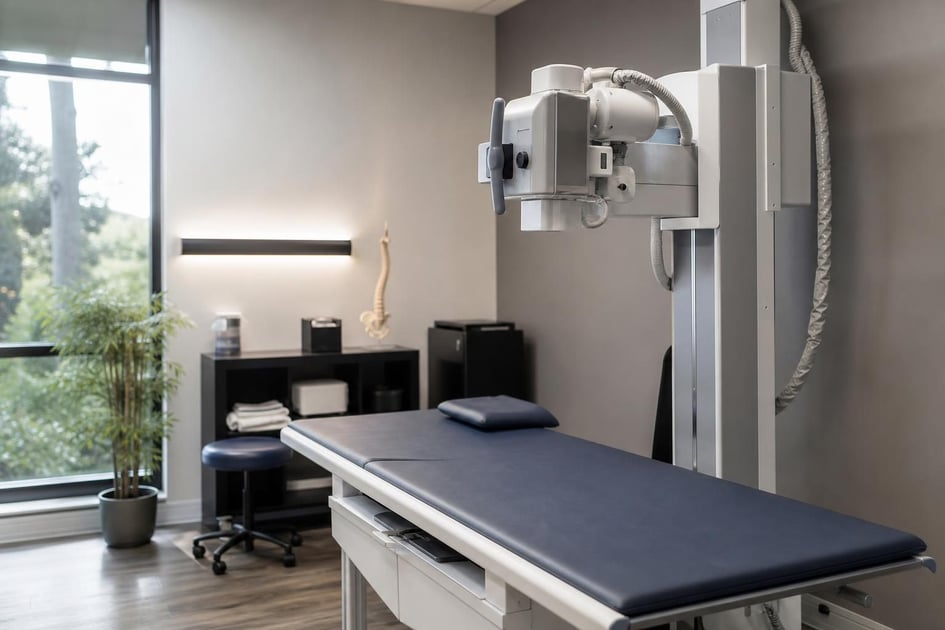
New systems typically range from $35,000 for a basic digital radiography room to over $150,000 for a DR room with multiple detector plates and PACS integration. Financing a new unit with challenged credit is possible, but expect the lender to ask for 10% to 20% down and a term of 36 to 60 months. New equipment carries stronger resale value, which reduces lender risk.
Used and Refurbished Units
A refurbished fixed x-ray room can cost $15,000 to $40,000 depending on tube age, generator capacity, and whether digital detectors are included. Used equipment financing with bad credit is often easier to approve because the lower loan amount reduces exposure. A $20,000 used unit with 15% down is a $17,000 risk—well within the tolerance of many equipment lenders even for lower credit tiers.
Portable vs. Fixed Systems
Portable x-ray machines cost less—often $8,000 to $25,000 for refurbished units and $20,000 to $45,000 new. The lower price point makes them an accessible option for mobile imaging services and satellite clinics. Portable X Ray Machine financing is often structured on shorter terms because the equipment depreciates faster than fixed-room systems.
| Factor | New Digital System | Used/Refurbished Unit | Portable Unit |
|---|---|---|---|
| Typical cost range | $35,000–$150,000+ | $15,000–$40,000 | $8,000–$45,000 |
| Down payment (bad credit) | 15%–20% | 10%–15% | 10%–20% |
| Typical term | 36–60 months | 24–48 months | 24–48 months |
| Resale strength | Strong | Moderate | Moderate to low |
| Best for | Permanent practices | Budget-conscious buyers | Mobile/chiropractic/vet |
Lease vs. Loan: Which Structure Works Better with Challenged Credit?
With a bad credit profile, the lease-versus-loan decision matters because each structure shifts risk differently.
An equipment finance agreement (EFA)—essentially a loan with a fixed APR—is the most common structure for x-ray equipment. You own the machine from day one, and the lender holds a lien until the final payment. This works well if you plan to keep the equipment for its full useful life and want to claim depreciation.
A $1 buyout lease functions almost identically to a loan for tax purposes. You make monthly payments and own the equipment at the end for $1. The lender may offer this structure to a lower-credit borrower because the lease paperwork gives them stronger default remedies in some states.
A fair market value (FMV) lease is harder to obtain with bad credit. The lender takes more risk because the residual value is uncertain, and they may not want to own a used x-ray machine at lease end. If you are offered an FMV lease with challenged credit, read the buyout clause carefully.
Pro Tip: Ask your lender whether the quote is a lease or an EFA before you sign. Some sales reps use the word "lease" loosely for both structures, but the tax treatment and buyout obligations differ significantly. If you plan to own the equipment, insist on an EFA or $1 buyout documented in writing.
For tax year 2026, you may be able to deduct the full cost of qualifying x-ray equipment under Section 179, subject to the current-year limits. Because those limits adjust annually and depend on your total equipment purchases and taxable income, speak with a CPA before you structure the deal. Bonus depreciation continues to phase down from prior years, so the 2026 percentage may be lower than in 2025. A CPA can model whether an EFA or true lease gives you the faster write-off based on your specific tax situation.
What Lenders Actually Review Beyond Your Credit Score
The diagnostic imaging market spans thousands of independent practices nationwide, according to U.S. Census Bureau business establishment data. Lenders who serve this market look at more than a three-digit score.
Time in Business
Most equipment lenders prefer two or more years in business, but that is not a hard rule for medical equipment. A chiropractic practice with 18 months of consistent revenue and a documented patient base can often qualify for x-ray financing even with a credit score below 620. The key is demonstrating that the equipment will generate revenue, not just add overhead.
Monthly Revenue and Bank Deposits
Expect to provide three to six months of business bank statements. Lenders look for steady deposits, not just top-line revenue. If your practice collects $30,000 per month in patient payments but shows frequent overdrafts, that is a red flag. Keep your average daily balance healthy in the months leading up to application.
Equipment Type and Age
Lenders prefer name-brand equipment with established service networks. A Canon, Carestream, or GE system from a licensed dealer is easier to finance than a gray-market import with no US service support. The equipment age matters too. A 2022 digital system is stronger collateral than a 2012 unit with an unknown tube count.
Down Payment or Trade-In Equity
With bad credit, cash down is your strongest negotiating tool. Even 10% down on a $50,000 machine reduces the lender's exposure to $45,000 and signals your commitment. If you have an existing film-based x-ray unit to trade in, get a written trade-in value from the dealer and present it as equity.
Documentation You'll Need to Keep Approval Moving
Incomplete paperwork kills more bad-credit deals than the credit score itself. Have these ready before you apply:
- Business bank statements (last 3–6 months)
- Current equipment quote or purchase agreement from a verifiable vendor
- Business tax returns (last one to two years)
- A brief explanation letter for any major derogatory marks—bankruptcy, repossession, or large tax liens
- Proof of business registration and any required medical imaging licenses
If your credit report shows a prior repossession of medical equipment, address it head-on. Explain the circumstances, what changed, and why this deal is different. Lenders have seen practices recover from equipment repossessions during temporary downturns; hiding the history looks worse than the event itself.
See what you qualify for
The equipment itself secures the financing, which keeps rates competitive. Checking your options takes minutes.
Check Your OptionsReal-World Cost Examples for X-Ray Machine Financing
These examples assume a borrower with a credit score between 580 and 640, two-plus years in business, and monthly revenue sufficient to cover the payment. Rates vary by credit profile, equipment age, and term.
Example 1: Used portable unit for a mobile veterinary service
- Equipment cost: $18,000
- Down payment: $2,700 (15%)
- Amount financed: $15,300
- Term: 36 months
- Estimated monthly payment: mid-$400s to low-$500s
Example 2: New digital x-ray system for a chiropractic clinic
- Equipment cost: $65,000
- Down payment: $9,750 (15%)
- Amount financed: $55,250
- Term: 48 months
- Estimated monthly payment: high-$1,200s to low-$1,400s
Example 3: Refurbished fixed room for a small orthopedic practice
- Equipment cost: $42,000
- Down payment: $4,200 (10%)
- Amount financed: $37,800
- Term: 60 months
- Estimated monthly payment: high-$700s to low-$900s
By the Numbers: On a $50,000 x-ray system with 15% down, every 12 months you shorten the term raises the monthly payment by roughly 15% to 20%, but cuts total interest cost by a proportionally larger amount. If your cash flow can handle a 48-month term instead of 60, the savings often exceed $3,000 to $5,000 over the life of the deal.
Common Mistakes Buyers with Bad Credit Make
Business credit trends reported by Forbes show that equipment-heavy borrowers who monitor their credit regularly secure better terms over time. Until your score recovers, avoid these common errors.
Shopping only on monthly payment. A lower payment stretched over 72 months can leave you owing more than the equipment is worth. Focus on total cost of ownership, not just the monthly figure.
Applying everywhere at once. Each hard inquiry dings your credit score. Work with one or two equipment-specific lenders rather than shotgun-applying to general business loan sites.
Not getting a firm equipment quote first. Lenders need a vendor invoice to fund. If you apply with a rough estimate and the actual invoice comes in 20% higher, you may need to re-underwrite.
Ignoring the service contract. X-ray machines require annual calibration and tube maintenance. A $400-per-month payment is manageable until you face a $6,000 tube replacement. Build service costs into your budget or negotiate a warranty period with the seller.
What Happens After You Apply
Once you submit a complete application with your equipment quote and bank statements, the review process typically takes a few hours to one business day. Same-day approvals are possible when the file is clean and the equipment is from a known vendor.
If approved, you will receive a term sheet outlining the monthly payment, term, down payment requirement, and any documentation conditions. Review the UCC filing language and prepayment policy. Most equipment finance agreements allow early payoff, but some apply a prepayment penalty or keep a portion of the remaining interest.
After you sign and return the documents, the lender pays the vendor directly. You never handle the loan proceeds. The vendor ships and installs the equipment, and your payments begin according to the schedule. Ready to move forward? Talk to a specialist about your specific machine and get a decision on your x-ray equipment financing today.
Tax Treatment for X-Ray Equipment in 2026
For tax year 2026, Section 179 allows businesses to deduct the full purchase price of qualifying equipment in the first year, subject to an annual limit and a total equipment purchase threshold. Because those specific dollar amounts change with inflation adjustments and legislative updates, consult a CPA to confirm the exact 2026 limits before you file. The deduction cannot exceed your taxable business income, so a practice showing a loss may need to carry the benefit forward.
Bonus depreciation continues its scheduled phase-down from the elevated levels of prior years. For 2026, the first-year bonus percentage is lower than in previous years, meaning more of your deduction may need to come from Section 179 or standard MACRS depreciation. Again, a tax professional can model the optimal strategy based on your projected 2026 income.
If you choose a true lease rather than a loan or EFA, you typically deduct the lease payments as a business expense rather than depreciating the asset. This can simplify bookkeeping but may not yield the same front-loaded tax benefit. Run both scenarios with your CPA before you commit to a structure.
Key Insight: Lenders do not check your tax return to verify you will take a Section 179 deduction. They underwrite based on cash flow. But if you are counting on the tax savings to cover your down payment, get a CPA letter or projection first. A denied deduction should not leave you short on the deposit.
Ready to move forward?
More than 10,000 businesses have financed equipment with Provide Capital. See what you qualify for today.
Get StartedFAQ
Can I get x-ray machine financing with a credit score under 600?
Yes, but expect stricter terms. You will likely need 10% to 20% down, documented revenue for at least 12 months, and equipment from a recognized vendor. The equipment itself as collateral is what makes approval possible despite a low score.
Does the lender check my business credit or personal credit?
For most practices under $5 million in revenue, the lender checks both. Personal credit carries more weight when the business file is thin. If your business credit is strong but personal credit is weak, highlight that in your application.
How fast can I get funded?
Same-day approvals are possible with a complete file. Funding typically occurs within 24 to 72 hours after you sign documents, assuming the vendor is responsive. Delays usually come from missing paperwork, not the credit decision itself.
Can I finance a used x-ray machine from a private seller?
Private-party deals are harder. Lenders prefer vendors they can verify and who offer installation support. If you buy from a private seller, expect the lender to require an independent equipment appraisal and proof of clear title.
Will financing an x-ray machine help rebuild my credit?
Yes, if the lender reports to business credit bureaus. Ask before you sign. Not all equipment lenders report, so if credit rebuilding is a goal, choose one that does and make every payment on time.
What happens if I need to upgrade before the term ends?
Most lenders allow early payoff or a trade-in refinance. Ask about the prepayment schedule. Some charge no penalty after 12 or 18 months. Others use a fixed percentage of the remaining balance. Get this in writing before you commit.
Do I need a down payment if I have bad credit?
In most cases, yes. With credit below 640, plan on 10% to 20% down. Strong revenue and a long time in business can sometimes reduce that requirement, but cash down remains the fastest way to improve your approval odds.
Is X Ray Machine financing different from other medical equipment loans?
The structure is similar, but x-ray systems have higher collateral value and longer useful lives than many other medical devices. That stability makes them slightly easier to finance than equipment with rapid obsolescence, even for borrowers with damaged credit.
Next Steps
Bad credit narrows your options, but it does not close them. If you have an equipment quote, a few months of stable bank statements, and a clear plan for how the x-ray machine will serve your patients, you have what most lenders need to say yes. Digital X Ray Machine financing works the same way: the equipment secures the deal, and same-day decisions are possible when your file is complete. Whether you run a chiropractic clinic, a veterinary practice, or a mobile imaging service, the process starts with a completed application and a vendor quote. Get a same-day decision on your equipment and move your practice forward.
Provide Capital serves businesses nationwide across construction, healthcare, dental, restaurant and food service, manufacturing, transportation, agriculture, HVAC, and Forestry Logging equipment financing. From $5,000 to $5 million, the equipment itself is the collateral.
Disclaimer: The information provided in this article is for general educational purposes only and is not financial, legal, or tax advice. Funding terms, qualifications, and product availability may vary and are subject to change without notice. Provide Capital does not guarantee approval, rates, or specific outcomes. For personalized information about your business funding options, contact our team directly.