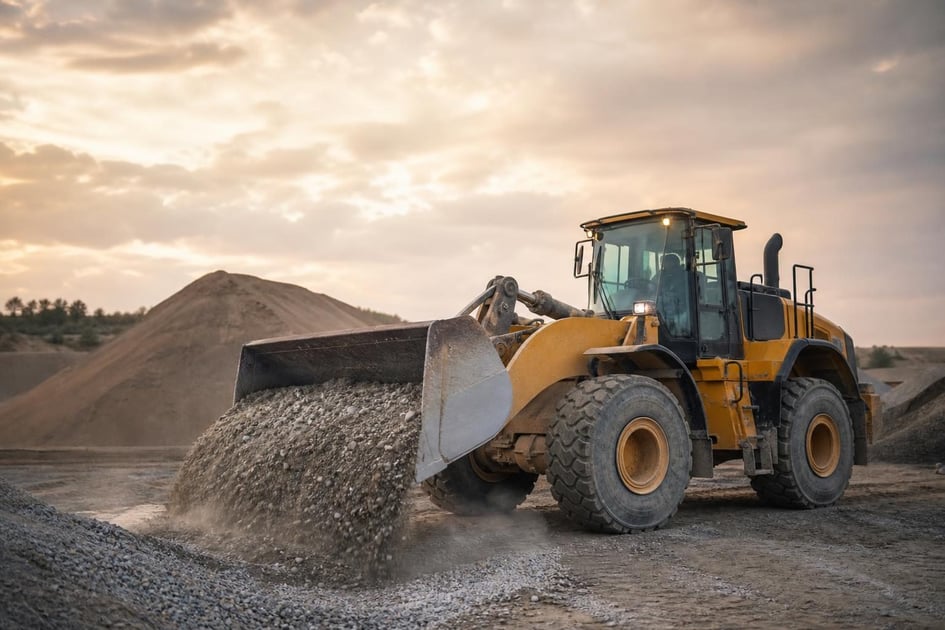
You can finance a wheel loader with subprime credit if the machine qualifies as collateral, your business shows consistent cash flow, and you are prepared to put 10% to 30% down. The equipment itself secures the transaction, which is why Provide Capital can consider applications across the full $5,000 to $5 million range, including same-day decisions when the file is complete. Expect to document your revenue, verify the seller, and choose between a loan and a lease structure before funding.
Why Lenders View Wheel Loaders as Strong Collateral
Wheel loaders retain value better than many asset classes. A well-maintained unit from a major manufacturer can command 50% to 70% of its original value at five years, depending on hours and undercarriage condition. That resale predictability matters when your credit profile is already under pressure. The lender's security interest is in the machine itself, so the primary question is whether the collateral can cover the remaining balance in a remarketing scenario.
Major brands dominate the secondary market. Auction data shows that standard-wheel, 2- to 4-cubic-yard loaders move quickly in the Southeast and Midwest construction belts. Lenders know that if a borrower defaults, they can repossess and liquidate without the protracted delays common with specialized or custom-built equipment.
Versatility also protects value. A single wheel loader can run a general-purpose bucket, forks for palletized material, a grapple for brush, or a snow pusher for winter work. That multi-season utility means demand stays steadier year-round than for single-purpose attachments or dedicated machines.
Key Insight: Most equipment finance companies apply a maximum age-and-hour cap to used collateral, but wheel loaders often receive more flexibility than excavators because their power trains are easier to inspect and their frames do not suffer the same torsional stress. A loader with 8,000 hours and a clean maintenance log can still qualify for standard terms, whereas a similarly aged tracked machine might require a larger down payment or shorter amortization.
Serial-Number Tracking and Condition Verification
Unlike smaller tools, wheel loaders carry VIN-style serial numbers and standardized hour meters. That traceability lets lenders run lien checks and order third-party appraisals. For you, that means a transparent process: the cleaner the paper trail, the less friction in underwriting. If you are buying used, ask the seller for the last 2,000 hours of service records. Lenders view documented PM history almost as favorably as a low-hour machine.
How Bad Credit Actually Affects Your Terms (No Guarantees)
"Bad credit" is not a single category. A 620 personal FICO with a recent bankruptcy discharge is different from a 580 score with three open collections and declining revenue. Equipment lenders look at the totality of the file: time in business, monthly gross deposits, existing debt service, and the quality of the collateral.
With challenged credit, expect the following adjustments:
- Larger down payment: 10% to 30% is typical, compared with 0% to 10% for prime borrowers.
- Shorter term: 36 to 48 months instead of 60 to 72.
- Collateral restrictions: Newer equipment, or used units with lower hours, may be required.
- Personal guarantee: Usually mandatory for owners with sub-650 credit.
Same-day approvals are possible, but only when your file is complete and the collateral checks out. There is no guaranteed approval, and every application receives individual underwriting.
Credit Tiers and What They Mean
Equipment finance companies often sort applications into risk tiers. A-tier borrowers may see minimal down payments and longer terms. B-tier files show minor derogatory items but strong cash flow. C-tier and D-tier deals—where many bad-credit applications land—rely heavily on collateral equity and debt-service coverage. If you are below 600, you are likely in the C or D range, which means the wheel loader must carry the deal. The machine becomes the star of the file, not your score.
Public Records and Tax Liens
Open tax liens, unsatisfied judgments, or recent repossessions are red flags. They do not always kill the deal, but they usually cap the term at 36 months and push the down payment toward the high end of the range. Satisfying an old lien before applying—even if it does not immediately raise your score—shows the underwriter that you are addressing past obligations.
Pro Tip: If your credit was damaged by a single event—such as a medical collection or a prior business closure—write a short narrative explaining the event, the date it was resolved, and how your current operation generates stable cash flow. Underwriters call this a "letter of explanation," and in equipment finance it can be the difference between a marginal decline and an approval with conditions.
New vs. Used Wheel Loaders: Financing Trade-Offs
Should you buy new or used? With impaired credit, the choice has real consequences for approval odds and total cost.
New machines carry full manufacturer warranties and predictable maintenance costs, which lenders like because they reduce the risk of a broken-down asset securing the loan. However, new equipment commands a higher absolute price, which raises your monthly obligation.
Used wheel loaders lower the financed amount and can improve your debt-service-coverage ratio. The risk is that older units may need immediate repairs, and some lenders cap used equipment at 10 to 15 model years or a specific hour threshold.
| Factor | New Wheel Loader | Used Wheel Loader (Qualified) |
|---|---|---|
| Down payment range | Often 10% to 20% for challenged credit | Often 15% to 30% for challenged credit |
| Term available | Up to 60–72 months | Typically 36–60 months |
| Rate structure | Rates vary by credit profile, equipment age and term | Rates vary by credit profile, equipment age and term |
| Collateral flexibility | Broad approval; warranty backs value | Must pass inspection; hours and service history reviewed |
| Monthly payment | Higher absolute dollars | Lower absolute dollars |
The table shows general patterns, not promises. Your specific profile and the machine's specifications determine the exact structure.
Certified Used Programs vs. Auction Buys
Manufacturer-certified used programs give lenders confidence because the machine passed a factory inspection. If you are buying at auction, the burden of proof shifts to you. Obtain an independent inspection report and verify that the auction house provides clear title. Auction bargains can turn into underwriting headaches if the serial number shows an outstanding lien from a previous owner.
Model-Year and Hour Thresholds
Most finance companies prefer used wheel loaders with fewer than 10,000 to 12,000 hours. Above that, you may still get funded, but expect a shorter amortization and a larger equity injection. Machines older than 15 to 20 years often move into "collateral-only" programs where the down payment approaches 30% to 50% of the purchase price.
Lease vs. Loan: Which Structure Works with Impaired Credit?
An equipment loan and a $1 buyout lease look similar on the surface—both give you ownership after the final payment—but they treat credit risk differently.
In a loan, the lender files a UCC-1 lien against the equipment. You own the title once the balance is zero. In a Fair Market Value (FMV) lease, the lessor owns the asset and rents it to you. At the end, you can buy it at fair market value, return it, or upgrade.
For borrowers rebuilding credit, the $1 buyout lease is often easier to approve because the lessor retains legal ownership and can claim depreciation. However, FMV leases are harder to obtain with subprime credit because the lessor is betting on a residual value that may not materialize.
Construction firms usually prefer loans or $1 buyout leases because they intend to run the equipment until the engine gives out. A loan also keeps the asset off the lessor's books if you plan to trade it in five years.
By the Numbers: A $120,000 wheel loader on a 48-month term with a 20% down payment leaves a $96,000 balance. On a loan, that balance amortizes to zero and you own a machine still worth roughly $60,000 to $75,000 on the used market three years later. On an FMV lease, you would have paid less per month but face a residual balloon payment or lose the equity entirely. For an owner-operator counting on trade-in value, the loan structure preserves capital even when monthly cash outlay is higher.
What Underwriters Want to See When Credit Is Thin
Provide Capital can consider applications across the full $5,000 to $5 million range. With bad credit, the underwriter's focus shifts from your score to your operation's ability to cover the new payment.
Bank Statements and Cash Flow
Expect to submit three to six months of business bank statements. Underwriters look for positive ending balances, consistent deposit volume, and no recent overdrafts. If your gross monthly deposits are at least 1.25 to 1.5 times your total debt service—including the new wheel loader payment—you are in the conversation.
Debt-Service Coverage Ratio (DSCR)
DSCR is your net operating income divided by total debt payments. A ratio above 1.25 is the unofficial floor for most subprime equipment deals. If you are at 1.1 or below, the lender may still approve the deal if you increase the down payment or add a strong co-signer.
Equipment Specs and Seller Verification
The lender needs a detailed invoice or equipment listing: year, make, model, serial number, hours, attachments, and condition notes. If you are buying from a private party, the underwriter will verify that the seller has clear title. If you are buying from a dealer, the dealer's invoice serves as the primary documentation.
Time in Business
Most equipment finance programs prefer two or more years in operation. If you have been in business less than two years, you may still qualify, but the down payment requirement usually rises and the maximum term shortens.
Trade References
Some underwriters ask for two to three trade references from vendors or suppliers. A reference confirming you pay your parts house or fuel vendor on time can offset a thin credit file.
The Role of the Personal Guarantee
With subprime business credit, the personal guarantee is standard. The underwriter will pull a personal credit report and may ask for a personal financial statement. A defaulted guarantee can affect your personal credit, so treat the commitment seriously.
If you have the equipment quote and three months of bank statements, see what you qualify for without affecting your credit score.
How to Improve Your Approval Odds Before Applying
You cannot fix a credit score overnight, but you can strengthen the file.
Clean Up Your Bank Statements
Stop writing checks that bounce. Underwriters scan for NSF fees and negative days. Two or more NSF events in the last 90 days can push an otherwise approvable file into a decline or a larger down payment.
Reduce Existing UCC Filings
If you already have two or three equipment loans, the new lender knows your cash is stretched. Paying off a small balance and terminating the old UCC filing before applying can improve your DSCR instantly.
Bring a Co-Signer or Additional Guarantor
A business partner or spouse with stronger credit can strengthen the guarantor pool. The lender may weight the higher score more heavily, which can lower the down payment requirement or extend the term.
Tax Treatment for 2026
How you structure the deal affects your 2026 tax position. Consult a CPA before signing.
Section 179 Deduction
For tax year 2026, Section 179 allows businesses to deduct the full purchase price of qualifying equipment up to the annual limit set for 2026, provided the asset is placed in service before December 31, 2026. The deduction phases out dollar-for-dollar once total equipment purchases exceed a separate 2026 threshold. Because both limits adjust with inflation and Congressional action, confirm the exact 2026 figures with your accountant before relying on them for cash-flow planning.
Bonus Depreciation
Bonus depreciation for 2026 is subject to scheduled phase-down rules under current federal law. Depending on when the equipment is placed in service, you may be able to take an additional first-year depreciation percentage on the remaining basis after any Section 179 deduction. The exact percentage for 2026 depends on legislation and IRS guidance for the tax year. Your CPA can model whether Section 179, bonus depreciation, or standard MACRS delivers the better outcome for your bracket.
MACRS and the Seven-Year Schedule
If you do not front-load deductions via Section 179 or bonus depreciation, wheel loaders fall under the seven-year MACRS property class. That spreads the write-off across eight calendar years due to the half-year or mid-quarter convention. For a profitable 2026, spreading the deduction might make sense if you expect higher marginal rates in future years.
Lease Payments as an Operating Expense
If you choose a true lease—where the lessor retains ownership and you do not assume a $1 buyout—you can generally deduct the monthly lease payment as a business expense in 2026. This simplifies record keeping but means you do not build equity. Match the structure to your long-term equipment strategy, not just the tax year deduction.
Construction spending has remained elevated nationally, according to U.S. Census Bureau data, which supports strong resale values for loaders in most regional markets. The Small Business Administration notes that asset-backed financing is a primary path for established firms to acquire machinery without tapping working-capital lines. Industry coverage from Forbes confirms that lenders increasingly weight cash-flow data over personal credit scores when the collateral is commercial-grade equipment.
Documentation to Gather Before You Apply
A complete file speeds up the process. When you are aiming for a same-day decision, missing documents are the most common delay.
- Business bank statements: Last three to six months, all pages.
- Equipment quote or purchase agreement: Must show seller information, serial number, price, and condition.
- Business entity documents: Articles of incorporation, operating agreement, or partnership docs.
- Driver's license and voided check: For identity verification and auto-debit setup.
- Proof of insurance: The lender will be listed as loss payee and additional insured.
- Current debt schedule: A list of existing equipment loans and their balances.
Pro Tip: If you are buying at auction, obtain the auction listing sheet and the payment terms before applying. Some auction houses require payment within 24 to 48 hours of winning the bid. Tell your finance company the auction deadline upfront so they can structure a wire or certified-funds process that matches the auction house's timeline. Missing the payment window can void the sale and cost you the deposit.
Industry Context: Where Wheel Loaders Earn Their Keep
Wheel loaders are not limited to sitework. In agriculture, they handle feed and manure. In forestry, they sort logs and load trucks. In snow removal, a quick-attach bucket swap turns a summer dirt machine into a winter profit center. That versatility is why lenders continue to see them as desirable collateral even when credit is bruised.
Construction remains the dominant market. Spring and early summer represent the busiest buying season, which means inventory turns quickly and used prices firm up. If you are shopping in late fall or winter, you may find softer pricing on used units as dealers clear lot space, but you also face a thinner selection.
For contractors already running an excavator or dump truck, adding a wheel loader can reduce subcontractor bills for material handling. Construction equipment financing often bundles multiple units under a single master line, but with challenged credit it is usually smarter to close one transaction successfully before stacking others.
Wheel Loaders financing is structured around the machine's hours, year, and brand. If a wheel loader is not the right fit for your current jobs, consider related equipment. Backhoe Loader financing offers digging and loading in one unit, while Skid Steer Loader financing fits tighter residential sites where a full-size loader is overkill.
Mistakes Owners Make When Financing with Poor Credit
Shopping on Rate Alone
With subprime credit, the lowest advertised rate rarely applies to your file. Focus on total cost of ownership, prepayment penalties, and whether the term leaves you upside-down on the collateral.
Overbuying the Machine
A 4-cubic-yard loader costs significantly more than a 2.5-cubic-yard unit. If your contracts are mostly residential driveways and small commercial pads, the larger machine burns extra fuel and carries a higher payment without generating matching revenue.
Ignoring the UCC Filing Process
Equipment lenders file a UCC-1 financing statement against the serial number. If you later try to use the same loader as collateral for a working-capital loan, the new lender will see the existing lien. Do not promise the same asset to multiple creditors.
Skipping the Pre-Purchase Inspection
On used equipment, hire a mechanic to check the transmission, differential, and hydraulic pressures. A $300 inspection can save you from financing a machine that needs $15,000 in repairs in the first quarter.
Neglecting Insurance Requirements
Lenders require physical damage insurance naming them as loss payee. If you let the policy lapse, you are in technical default even if your payments are current. Set the premium to auto-renew.
What Happens After Approval
Once approved, you will receive a term sheet or finance agreement. Review the payment schedule, late-fee policy, and insurance requirements. The lender typically pays the seller directly via wire or check; you do not take a cash payout.
After funding, the lender files the UCC-1. Your first payment is usually due 30 to 45 days later. Set up automatic ACH to avoid missed payments, which further damage credit and can trigger default provisions.
Some lenders require a GPS or telematics device on higher-risk deals. The device helps locate the collateral in a default scenario. It is standard practice and does not mean the lender expects a problem; it is simply a risk-management tool.
If your operation improves and your credit recovers, ask about refinancing or early payoff after 12 to 18 months. Some contracts include a declining prepayment penalty; others allow payoff at any time with minimal fees. Read the documents before signing so you know your exit options.
Ready to add a loader to your fleet? Get a same-day decision on your equipment when you submit a complete file and seller quote.
Frequently Asked Questions
Can I get wheel loader financing with a credit score under 600?
It is possible, but expect stricter terms. The lender will weigh your time in business, cash flow, and collateral quality more heavily than the score itself. A larger down payment and a newer machine improve your odds. No outcome is guaranteed.
How much down payment will I need?
Most subprime equipment finance deals require 10% to 30% down, depending on credit severity, equipment age, and time in business. Newer loaders and stronger bank deposits move you toward the lower end of that range.
Will applying hurt my credit?
Provide Capital reviews your file to determine the best path forward. A hard inquiry may occur later in the process, but the initial review is designed to assess fit without unnecessary credit pulls.
Can I finance a private-party sale?
Yes, but the seller must prove clear title. The lender will run a lien search on the serial number and may require a third-party inspection. The funding process takes slightly longer than a dealer transaction because the seller is not a familiar vendor to the finance company.
Is a same-day approval really possible?
Same-day approvals are possible when the application is complete, the collateral is straightforward, and the seller is responsive. Missing bank statements or an incomplete equipment spec sheet are the usual delays.
Should I choose a loan or a lease with bad credit?
Loans and $1 buyout leases are more common for borrowers rebuilding credit because they build equity. True FMV leases are harder to secure with subprime profiles. Match the structure to how long you plan to keep the machine.
What tax benefits apply to a 2026 purchase?
For tax year 2026, you may be eligible for Section 179 expensing, bonus depreciation subject to phase-down rules, or standard MACRS depreciation. Lease payments may also be deductible. Confirm the exact 2026 limits and your eligibility with a CPA before making a cash-flow decision.
What if the wheel loader needs repairs right after I buy it?
That is why inspection matters. If you finance a used machine, negotiate a dealer warranty or set aside a repair reserve. The lender does not cover mechanical failures; the debt remains your obligation even if the machine is in the shop.
Moving Forward
Wheel loader financing with bad credit requires preparation, not perfection. Gather your bank statements, identify the right machine for your revenue level, and be realistic about the down payment. The equipment itself is your leverage; choose a unit with a clean history, reasonable hours, and strong resale demand.
Talk to a specialist about your specific machine and see how the collateral can work in your favor.
Disclaimer: The information provided in this article is for general educational purposes only and is not financial, legal, or tax advice. Funding terms, qualifications, and product availability may vary and are subject to change without notice. Provide Capital does not guarantee approval, rates, or specific outcomes. For personalized information about your business funding options, contact our team directly.